

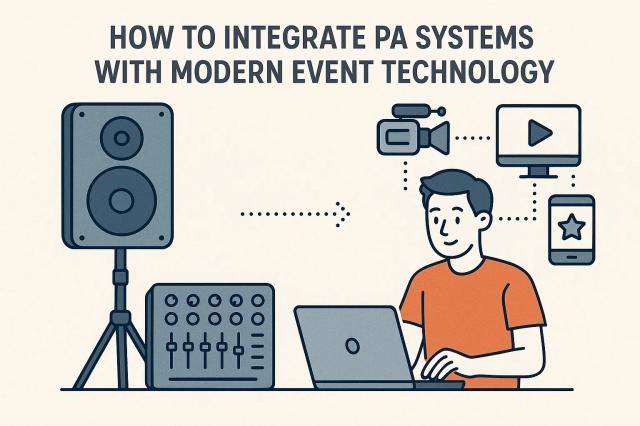
One of the most common questions from businesses regarding audio is how PA systems can integrate with the technologies they use for modern events. Event professionals of all types are discovering that when it comes to conferences, product launches, training seminars, or even office parties, there's more to "action in the room" than meets the eye. In the world of hybrid events, live streaming, video conferencing, and interactive apps are all critical elements in creating an experience that's immersive and interactive for everyone. With activity live in the room and running across digital channels, the importance of sound quality has never been greater. A good PA system is the secret weapon for reaching both room-based attendees and audiences beyond the venue.
Integrating sound systems with event technology
When an event is streamed to a screen, distributed via video conferencing, and run alongside a dedicated event app, audio is what unites them all. Every member of the audience, whether in the front row or the back, and even more so if they are in another country, will quickly lose patience with the muddy sound. Visuals, of course, can be attention-grabbing. But if speech isn't crisp, free of distortion or echo, and in sync with video, the whole impact of the event is lost. A PA system integrated with other event technology ensures that room-wide sound is consistently high on every platform the business broadcasts to, or receives from.
PA Systems and live-streaming
Live streaming is increasingly a core feature of events. If a clean feed is required for the digital stream, instead of a room pickup, the signal should be extracted directly from the audio mixer or control console and then passed into the streaming platform or app. This bypasses a standard amateur error, in which room microphones are sensitive to the nearest speakers, and consequently capture a feedback loop, echo, and unintelligible audio. Most professional mixing consoles are equipped with a dual output setup - one for the in-room speakers and another for the digital stream.
The same is true for video conferencing, or even a dedicated event app. Sound and video must be synchronised, or the streaming business will see viewers complaining about lips not matching speech. This can be avoided using the right audio interfaces and latency controls.
PA systems and video conferencing tools
Video conferencing services have been an office staple for years, and Zoom, Microsoft Teams, Google Meet and other platforms have seen ever greater use for corporate meetings and hybrid conferences. However, it is still rare to see conferencing tools integrated into event PA systems. While all these platforms have built-in audio capabilities, connecting them directly to larger event spaces usually results in microphones being unable to pick up soft speech or ambient noise from the room.
It also means every question or comment from participants in the room can be streamed clearly to participants joining the event online and vice versa. In fact, the switch between the two should be seamless, so that the discussion is experienced as a collaborative whole rather than two parallel activities. Feedback suppression and echo cancellation technology are critical to preventing sound from getting caught in a loop between microphones and speakers, another issue that throws a wrench in the flow. As with any event technology, it pays to test conferencing PA integration before the event begins, checking that levels and synchronisation are right.
PA systems and event apps
Interactive event apps have developed significantly in recent years. They are now packed with features that can make audiences more engaged than ever before. Live Q&A, polls and surveys, audience feedback, and other functions will be familiar to most businesses, but all of them can be significantly enhanced by integrating with a PA system. When paired with other audio, interactivity really comes to life, creating an environment where technology supports conversation instead of becoming a distraction from it.
Tips for successful integration
Successful integration of PA systems with streaming, video conferencing, and event apps isn't just a case of running cables from one thing to another. Businesses may choose equipment based on the goals of their event in advance. A company running a presentation-heavy seminar, or a more discussion-focused conference, or a show will look for different equipment to support these goals.
Mixers, as well as other equipment like audio interfaces, should be solid and ideally take multiple outputs. A rehearsal should also be run, and technical factors such as latency, feedback, or distortion should be tested, as well the qualitative transition between in-room speech and online discussion.
The best way for a business to have both the equipment and the technical expertise to complete a complex integration is by working with a trusted, experienced partner. In many cases, for companies that don't regularly run events, the decision to hire PA systems from reputable vendors can be more cost-effective than investing in them.
Delivering successful events in today's world often involves PA systems working in harmony with other digital tools. Audio keeps the communication clear between you and both your in-person and virtual audiences. Well-thought-out events with appropriate equipment and professional audio industry providers will put you in a great position to run a professional and memorable event. Of course, communication must also include visual design, and many consider including other elements, such as lighting hire in Perth and beyond. A hybrid experience can often wow an audience and create lasting memories.